WOMEN CINEMAKERS
direct link to the article:
https://issuu.com/cine-makers/docs/special.edition/216
42 pages
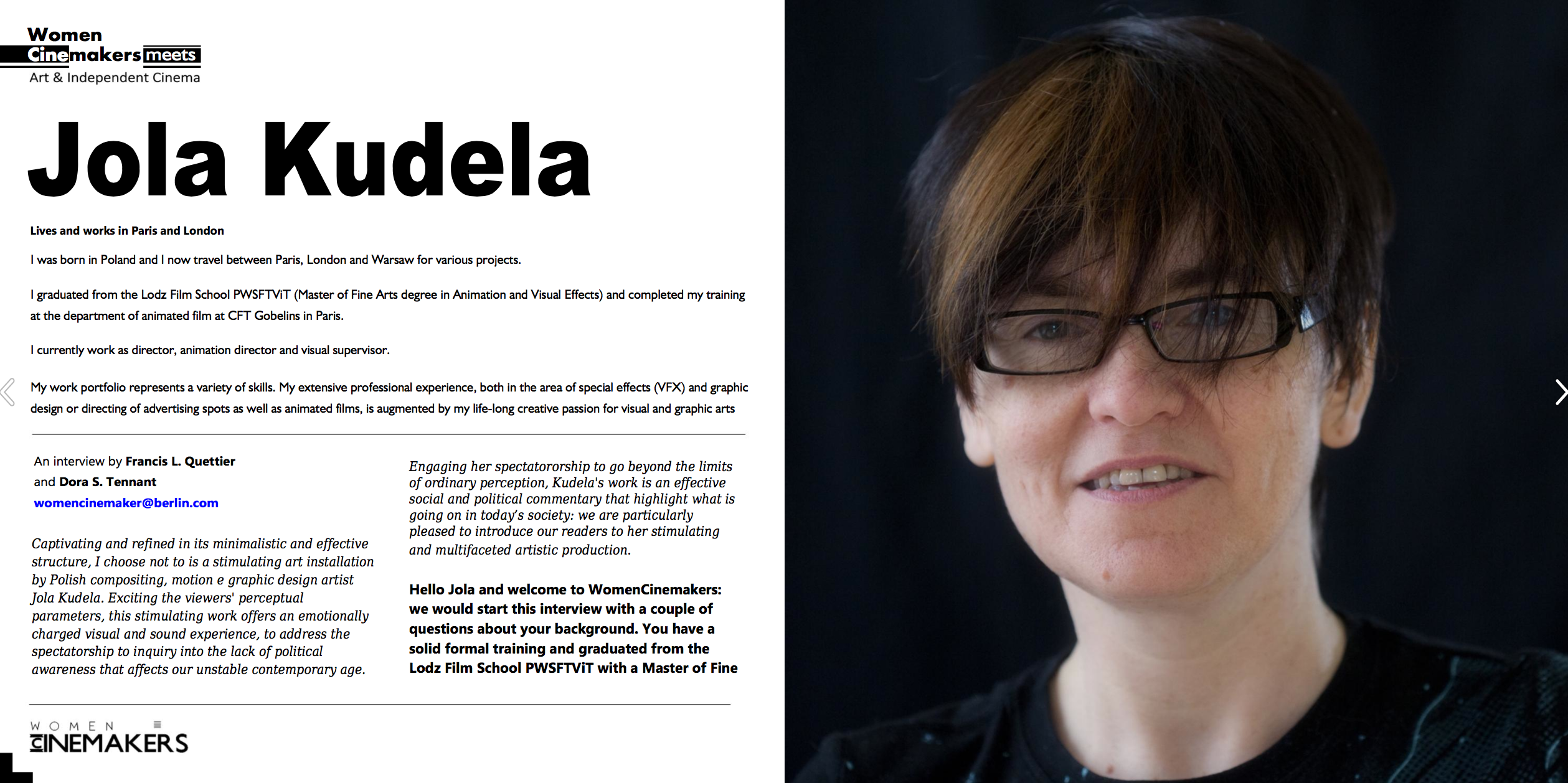
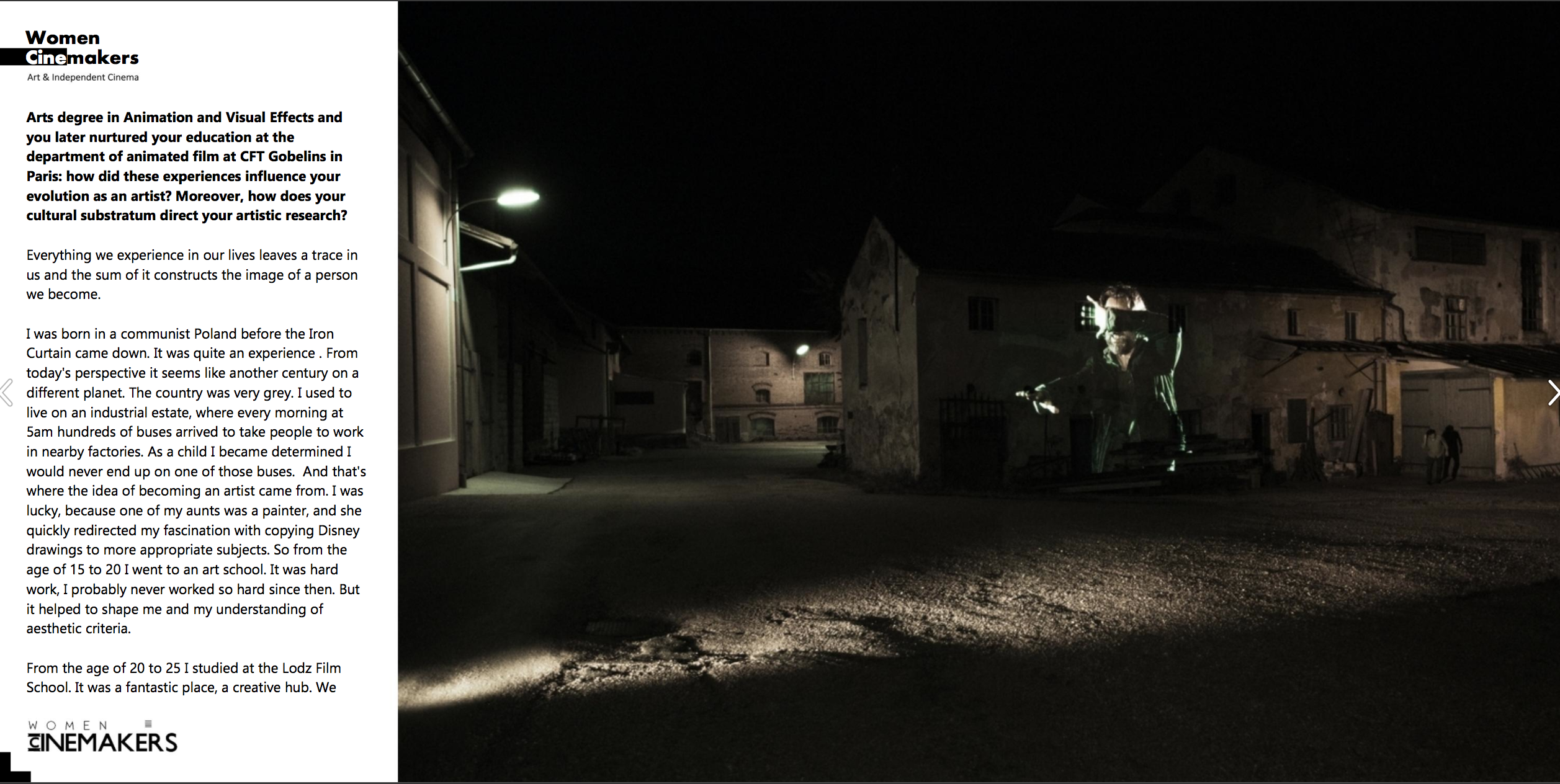
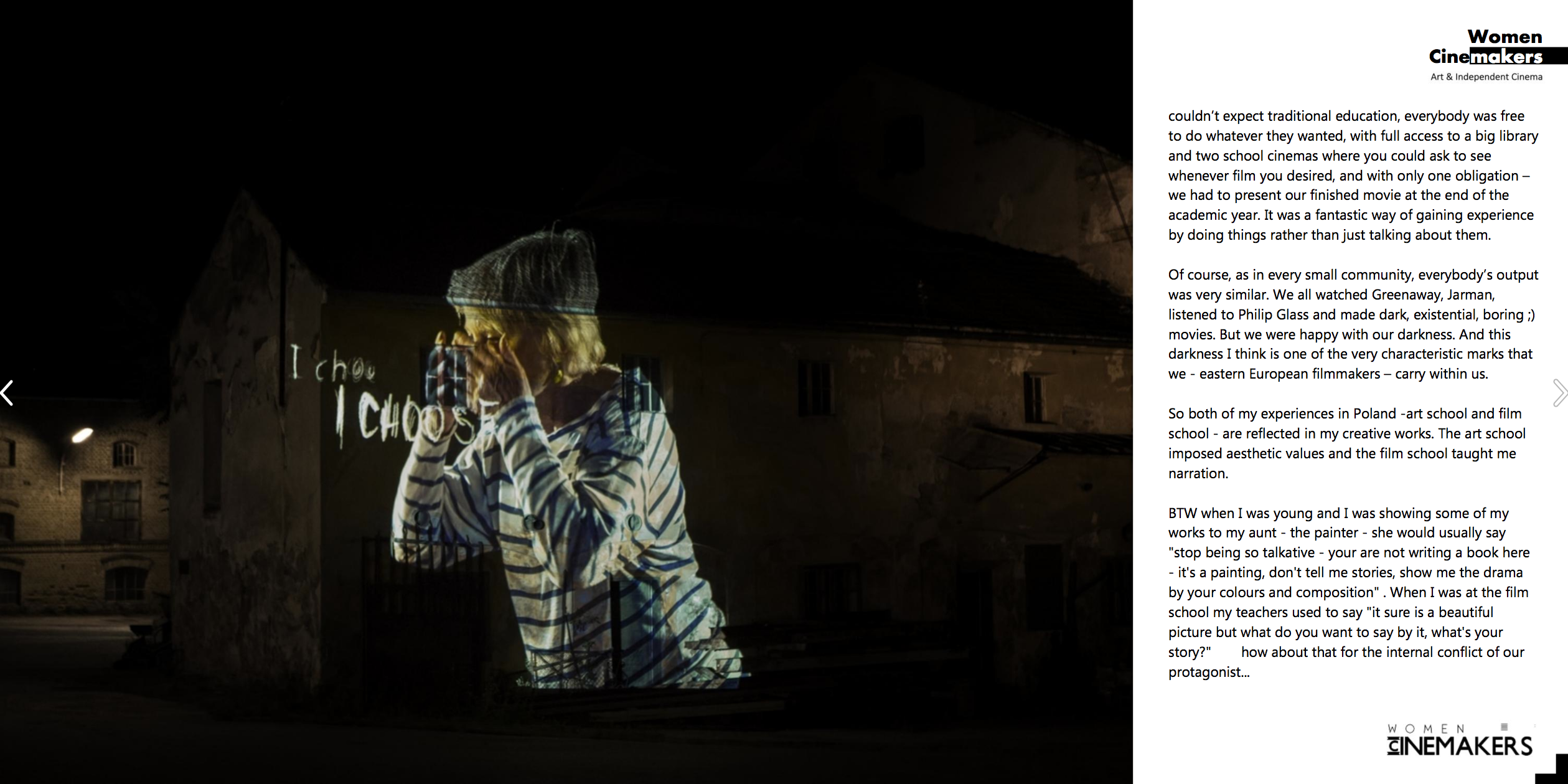
Captivating and refined in its minimalistic and effective structure, I choose not to is a stimulating art installation by Polish compositing, motion e graphic design artist Jola Kudela. Exciting the viewers' perceptual parameters, this stimulating work offers an emotionally charged visual and sound experience, to address the spectatorship to inquiry into the lack of political awareness that affects our unstable contemporary age. Engaging her spectatororship to go beyond the limits of ordinary perception, Kudela's work is an effective social and political commentary that highlight what is going on in today’s society: we are particularly pleased to introduce our readers to her stimulating and multifaceted artistic production.
1) Hello Jola and welcome to WomenCinemakers: we would start this interview with a couple of questions about your background. You have a solid formal training and graduated from the Lodz Film School PWSFTViT with a Master of Fine Arts degree in Animation and Visual Effects and you later nurtured your education at the department of animated film at CFT Gobelins in Paris: how did these experiences influence your evolution as an artist? Moreover, how does your cultural substratum direct your artistic research?
Everything we experience in our lives leaves a trace in us and the sum of it constructs the image of a person we become.
I was born in a communist Poland before the Iron Curtain came down. It was quite an experience . From today's perspective it seems like another century on a different planet. The country was very grey. I used to live on an industrial estate, where every morning at 5am hundreds of buses arrived to take people to work in nearby factories. As a child I became determined I would never end up on one of those buses. And that's where the idea of becoming an artist came from. I was lucky, because one of my aunts was a painter, and she quickly redirected my fascination with copying Disney drawings to more appropriate subjects. So from the age of 15 to 20 I went to an art school. It was hard work, I probably never worked so hard since then. But it helped to shape me and my understanding of aesthetic criteria.
From the age of 20 to 25 I studied at the Lodz Film School. It was a fantastic place, a creative hub. We couldn’t expect traditional education, everybody was free to do whatever they wanted, with full access to a big library and two school cinemas where you could ask to see whenever film you desired, and with only one obligation – we had to present our finished movie at the end of the academic year. It was a fantastic way of gaining experience by doing things rather than just talking about them.
Of course, as in every small community, everybody’s output was very similar. We all watched Greenaway, Jarman, listened to Philip Glass and made dark, existential, boring ;) movies. But we were happy with our darkness. And this darkness I think is one of the very characteristic marks that we - eastern European filmmakers – carry within us.
So both of my experiences in Poland -art school and film school - are reflected in my creative works. The art school imposed aesthetic values and the film school taught me narration.
BTW when I was young and I was showing some of my works to my aunt - the painter - she would usually say "stop being so talkative - your are not writing a book here - it's a painting, don't tell me stories, show me the drama by your colours and composition" . When I was at the film school my teachers used to say "it sure is a beautiful picture but what do you want to say by it, what's your story?" 😄 how about that for the internal conflict of our protagonist... 😜
When I came to France, I found their hedonistic and consumerist way of being very challenging. For the creative part - people just didn't understand what I was proposing. It was a different world. Sadness, nostalgia or just objectivism - scared them. It took me 10 years to stop trying to fit in, and to adopt a "subtle way of not giving the f..k"
So yes, I would say something quite obvious - our childhood and education in our young age determine what we do for the rest of our life. The main problem that I see in it, is how to deal with outside world and how to preserve and find your own voice even if it's against the accepted ‘norm’.
2) For this special edition of WomenCinemakers we have selected I choose not to, a captivating art installation that our readers have already started to get to know in the introductory pages of this article and that can be viewed at http://yolart.net/I-choose-not-to. What has at once captured our attention of your insightful inquiry into the lack of political awareness that affects our unstable societies is the way you have provided the results of your artistic research with such captivating aesthetics: while walking our readers through the genesis of I choose not to, would you tell how did you develope the initial idea?
The main idea started in Poland when "Law and Justice" political party won in the elections in 2015, and with the majority in the Polish parliament they started destroying democracy, while pushing towards fanatic nationalistic catholicism. I was shocked that people did nothing and let it happen. And then Brexit arrived in the UK and Trump in the USA. It was the same phenomenon - even if we don’t agree we follow blindly someone else’s choices. The idea gained an international context, so I began a series of photos of people who cover their eyes and refuse to see what’s going on - I pasted them up on the walls of different towns in Europe. The sentence " the blind leading the blind" seemed quite adequate as a title of the project.
Following that idea I decided to complete the project by moving images that I wanted to project on walls.
But this time I wanted to give the viewer a hint as to its meaning. At the same time i wanted to shift the meaning to a larger context. We, as the human race, feel justified to overpower other species and we are simply destroying the world without even noticing it. Our choice to be ignorant is distressing.
3) Elegantly shot, I choose not to features stunning cinematography and from a visual point is marked out with such a seductive beauty: what were your aesthetic decisions to achieve such powerful outcome? And what were your choices of camera and lens?
I wanted to have large-scale characters cut out from a background that I could project on city walls. The original facades of buildings would play the role of a background. And the main effect that i was interested in was the scale - a "blind" guy of the size of the 5 storey building would be quite a wake up call to the viewers.
So, as usual in my my paste ups, I was using green screen as the background, which enabled me to cut the characters out quickly. But in moving pictures, when you want to do the keying, you have to use quite a good equipment to avoid compression in the green. I used my Canon 5D camera, and even if I chose to shoot in RAW it wasn’t a perfect material for keying. So to make my life easier, I chose to shoot directly on black screen and to superimpose characters in postproduction. A bit like Norman Mclaren in "pas de deux"- it was one of my huge fascinations at film school and it still inspires me today apparently 😉
So I bought three "made in china" tangstens on ebay for £100 and a treadmill on ebay for £45… and i was ready for the shoot ... in my garden .... yes yes it was a purely home made production. What I really love nowadays - is this easy access to technology that allows us to do whatever we want. There are no more excuses – we can’t stay at home and complain that we are misunderstood artists who can't find the funds to finance our movies. You just keep it small and simple, and off you go!
So you asked me about my gear, like I said, Canon 5d mark III, canon lenses EF24-70 and EF100 , normally i use mainly EF16-35 but obviously not for this project.
I shot in RAW and ... one more essential detail that has helped a lot ... I have my own Flame Assist for postproduction. I bought it second hand after one of my commercial productions. I can use it now for work on my personal projects, so that simplifies the task a lot.
4) Both realistic and marked out with dreamlike quality, I choose not to reveals exquisite eye for the details and breathtaking editing style, to walk the viewers into a visionary adventure. We daresay that this video attempts to unveil the invisible that pervades our reality but that cannot be detected by our sensorial experience. Do you agree with this interpretation? Moreover, how do you consider the relationship between reality and imagination within your process?
Yes, the project is a little dreamlike, not much happens on the screen, only the symbolic synthesis of the idea. It’s a kind of a somnambulic dance, a motive that was very present in Polish art. The guys like Jacek Malczewski with the painting "Vicious Circle" (1897) , Stanislaw Wyspianski with a theatre play "Wesele" (1901) filmed by Wajda in 1973, or Wajda's film Ashes and Diamonds (1958).
They used it to criticise the focus on the consumerism and the lack of the will to fight for the right causes in our society. Times have changed, as well as the causes, but the apathy still remains.
5) I choose not to addresses the viewers to a wide number of narratives and we daresay that the desire for understanding that pervades it could be considered an effective allegory of human experience: would you tell us how much important is for you that the spectatorship rethink the concepts you convey in your artworks, elaborating personal meanings? How open would you like your works to be understood?
Usually i don't want to be too exact, too literal. I prefer to leave it up to the viewer to complete the sentence. I'm always afraid to be too serious, too boring or kitsch while using too obvious connotations. Leaving space for interpretation can be dangerous, you can just miss your goal, and people can misunderstand what you want to say. But it's not a documentary, and i presume the viewer will have some kind of a global awareness. I don't have to show oceans of plastic, dead polar bears, pollution, deformed kids born in radioactive areas, racist confrontations ect. i choose to show the emotions, the feeling, and the mass of people saying "i don't want to see it" seemed stronger to me.
There are keys to the interpretation - especially the character walking blindly on the industrial landscape , walking like a huge master of everything, and destroying everything as he walks. But if the viewer doesn't understand what it’s all about, then perhaps he or she is just like them, choosing not to think, choosing to be blind.
In another piece of mine "doubting Thomas" the connotation is quite far as well. The title is a clue to understanding. But you have to know the story of doubting Thomas, you will have to be aware of the analogy to the Caravaggio painting, you will have to realise that the Maori guy playing Thomas doesn't touch the wound of the Filipino guy playing Jesus. You will have to realise that he is painting and that paint is blood ect. What all that is supposed to mean? For me Thomas, by touching Christ’s wound, believed in his holiness, in my case the Maori guy creates his religion by painting and art is his religion.
So well it's not so obvious, perhaps it leaves too much space for interpretation. It’s easier and more simplistic to do stuff like "throwing a flower at a tank".
6) The minimalistic and penetrating soundtrack by David O'Brien provides I choose not to with such an unsettling atmosphere, to enrich the footage with an emotionally powerful sound tapestry: how do you see the relationship between sound and movement playing within your approach to moving images?
The music is a very important ingredient of the filmmaking. It gives you a tone, a rhythm, an ambience, the emotions. Music by itself is much closer to our feelings than a picture, it’s like a cry, like a voice, like a song. It's something internal and the picture is something external.
So most of the time, before i start working i choose the music first. That dictates the mood for my idea. It's like Eisenstein, with his idea of editing. You cross-edit a crying baby and a woman's face, and shooting soldiers with the woman's face, and your interpretation of the woman's emotions will change. The same with music. The same pictures with different music will be perceived differently. So before i start editing i choose the music and the music dictates the rhythm of the edit.
7) Another interesting work that we would like to introduce to our readers is entitled Doubting Thomas and it's inspired by a Caravaggio's painting and we have deeply appreciated the way you mix historical references to contemporary approach, to unveil the resonance between art from a past age and the issues of our unstable contemporary age: how do you consider this aspect of your practice? In particular, how do you see the relationship between past and present playing within your artistic research?
I'm constantly referring to the past, especially to the art history, in my projects. First of all, it's a kind of inheritance we’ve received, and can't ignore its existence. All our understanding of the world, contexts, analogies and symbols comes from it. We can't behave as if we are blank canvas, as if we’re coming from nowhere. Everything we are is a continuation, development and progression of our past and history.
I love playing with that as well. I like taking some known images and changing them according to the modern context. Very often by changing a little detail you can change its perception completely.
I once made an adaptation of da Vinci's ‘the Virgin and child with St.Anne’.
I kept the same composition and the subject, but recreated it with contemporary characters. The girl who was playing St. Anne had a shaven head. It created a big scandal in Poland. I was accused of robbing the image of its holly context by putting contemporary characters into the picture. People still read the baby as Jesus, the first girl as Mary, but the second woman was read as a lesbian, Mary's partner. Of course that was considered blasphemous. But I was asking a question - why did we assume that in the XVI century original the second woman wasn't a lesbian, but in today’s context she is? I think our perception is totally blinded by socially established clichés.
8) We have highly appreciated your insightful criticism on indifference and passivity to what is going on in today’s society: not to mention that these days almost everything, ranging from Marina Abramović's 'Dragon Heads' to Hannah Wilke's Through the Large Glass, could be considered political, do you think that your practice could be considered political, in a certain sense? In particular, do you think that your being a woman provides your artistic research with some special value?
Well, I always try to give meaning to my works. I wouldn't say it's political, but it’s socially engaged. We are living in difficult times and it's quite difficult to not to react to what’s going on or to make purely abstract, decorative creations.
Does being a woman provide added value? That is a large question. I would say it provides more handicaps in a social context. The world has been constructed by men and for men. But is the lower level of testosterone and being a member of a "lower class" influencing the creativity or does it give us a special power? I wouldn't say so. I place my subjects on a more human than gender level. But for sure there are hormonal differences in the brain between men and women and the perception of the wold and your place in it will be totally different, depending on your gender. But it’s not something I’m aware of in my art, and I have never approached it as a subject. Technically women is supposed to be more perceptive than a men, more fragile and attentive. It's supposed to be like that because our body and brains are prepared and adapted to breed children - something totally vulnerable and without any possibility of communication other than crying. We as a women are supposed to able to read the child’s body language, feel its emotions and needs.
We can use those skills in our professional life. From my own experience as an art director – as a woman I can see a larger spectrum of colours than my male co-workers. The difference sometimes is quite surprising.
But on a physical level being a woman is a big handicap when you have to work in unprotected environment. Being weaker and smaller than the other half of the population is a huge disadvantage and can be quite dangerous. I never go out on a shoot or for a street art project alone. I’ve experienced too many confrontations with males who wouldn't hesitate to use their strength to their advantage.
9) I choose not to has been awarded in several occasions and has been recently selected at the So Limitless and Free Film Festival in Montreal, Quebec: how much importance has for you the feedback that you receive in the festival circuit? And how do you feel previewing a film before an audience?
Actually it is very important. Most of my professional time is spent doing the commercial projects. As an art director, compositing artist ect. Only quite recently (in the last few years) I began to try to put more effort into my personal artistic research . It's very encouraging and motivating when you get positive feedback.
10) Before leaving this conversation we want to catch this occasion to ask you to express your view on the future of women in cinema. For more than half a century women have been discouraged from getting behind the camera, however in the last decades there are signs that something is changing. What's your view on the future of women in cinema?
The world is changing slowly, and the place of a woman in the society is evolving. We’ve gained freedom. (sadly only in this part of world, not everywhere). But here we can live now without a context of a man that we would belong to. It's a huge achievement. We are free with our choices and lives. So really, now it's only up to us, how we manage this freedom. I don't believe that these days if you have a good script a funding commission would refuse you the money because you are a woman. They can refuse it because they don’t know you or don’t consider you the right person, but it's a different story.
But there is another aspect of being a woman. We tend to have kids. And if a mother has a choice of take care of her kid or to spend days and nights on the shoot ... The choice usually is made for us. So that would always be a difference between men and women in their career progression
There is another danger in taking time off and delaying the start of your carrier. When you arrive on the market quite late, in your 40s or so, you’re not acknowledged anymore as a young and talented artist. Instead they tend to judge you through a filter of ageism. In addition, the world is ruled by tribes or a kind of private clubs. Quite often that there are mostly “boys' clubs". And If you are an outsider it is very difficult to get in, in most of cases. Women should perhaps work more together and be more supportive towards each other. Well, there’s a soluton to all this of course - you have to be better than the youngesters.😜
11) Thanks a lot for your time and for sharing your thoughts, Jola. Finally, would you like to tell us readers something about your future projects? How do you see your work evolving?
My artistic projects are on a stand-by at the moment, as I’m working as art director on a feature film in France. It's a co-production between France, Germany and Belgium, and it takes a lot of time and effort to coordinate everything. But the development time is finishing soon, and the German side will take over. I will have more time for myself and I’m planning to produce my next short movie. I don't really want to say more about it yet, because I’m sure it’ll change hundreds of times before I’ll finish it
https://issuu.com/cine-makers/docs/special.edition/216
42 pages
Captivating and refined in its minimalistic and effective structure, I choose not to is a stimulating art installation by Polish compositing, motion e graphic design artist Jola Kudela. Exciting the viewers' perceptual parameters, this stimulating work offers an emotionally charged visual and sound experience, to address the spectatorship to inquiry into the lack of political awareness that affects our unstable contemporary age. Engaging her spectatororship to go beyond the limits of ordinary perception, Kudela's work is an effective social and political commentary that highlight what is going on in today’s society: we are particularly pleased to introduce our readers to her stimulating and multifaceted artistic production.
1) Hello Jola and welcome to WomenCinemakers: we would start this interview with a couple of questions about your background. You have a solid formal training and graduated from the Lodz Film School PWSFTViT with a Master of Fine Arts degree in Animation and Visual Effects and you later nurtured your education at the department of animated film at CFT Gobelins in Paris: how did these experiences influence your evolution as an artist? Moreover, how does your cultural substratum direct your artistic research?
Everything we experience in our lives leaves a trace in us and the sum of it constructs the image of a person we become.
I was born in a communist Poland before the Iron Curtain came down. It was quite an experience . From today's perspective it seems like another century on a different planet. The country was very grey. I used to live on an industrial estate, where every morning at 5am hundreds of buses arrived to take people to work in nearby factories. As a child I became determined I would never end up on one of those buses. And that's where the idea of becoming an artist came from. I was lucky, because one of my aunts was a painter, and she quickly redirected my fascination with copying Disney drawings to more appropriate subjects. So from the age of 15 to 20 I went to an art school. It was hard work, I probably never worked so hard since then. But it helped to shape me and my understanding of aesthetic criteria.
From the age of 20 to 25 I studied at the Lodz Film School. It was a fantastic place, a creative hub. We couldn’t expect traditional education, everybody was free to do whatever they wanted, with full access to a big library and two school cinemas where you could ask to see whenever film you desired, and with only one obligation – we had to present our finished movie at the end of the academic year. It was a fantastic way of gaining experience by doing things rather than just talking about them.
Of course, as in every small community, everybody’s output was very similar. We all watched Greenaway, Jarman, listened to Philip Glass and made dark, existential, boring ;) movies. But we were happy with our darkness. And this darkness I think is one of the very characteristic marks that we - eastern European filmmakers – carry within us.
So both of my experiences in Poland -art school and film school - are reflected in my creative works. The art school imposed aesthetic values and the film school taught me narration.
BTW when I was young and I was showing some of my works to my aunt - the painter - she would usually say "stop being so talkative - your are not writing a book here - it's a painting, don't tell me stories, show me the drama by your colours and composition" . When I was at the film school my teachers used to say "it sure is a beautiful picture but what do you want to say by it, what's your story?" 😄 how about that for the internal conflict of our protagonist... 😜
When I came to France, I found their hedonistic and consumerist way of being very challenging. For the creative part - people just didn't understand what I was proposing. It was a different world. Sadness, nostalgia or just objectivism - scared them. It took me 10 years to stop trying to fit in, and to adopt a "subtle way of not giving the f..k"
So yes, I would say something quite obvious - our childhood and education in our young age determine what we do for the rest of our life. The main problem that I see in it, is how to deal with outside world and how to preserve and find your own voice even if it's against the accepted ‘norm’.
2) For this special edition of WomenCinemakers we have selected I choose not to, a captivating art installation that our readers have already started to get to know in the introductory pages of this article and that can be viewed at http://yolart.net/I-choose-not-to. What has at once captured our attention of your insightful inquiry into the lack of political awareness that affects our unstable societies is the way you have provided the results of your artistic research with such captivating aesthetics: while walking our readers through the genesis of I choose not to, would you tell how did you develope the initial idea?
The main idea started in Poland when "Law and Justice" political party won in the elections in 2015, and with the majority in the Polish parliament they started destroying democracy, while pushing towards fanatic nationalistic catholicism. I was shocked that people did nothing and let it happen. And then Brexit arrived in the UK and Trump in the USA. It was the same phenomenon - even if we don’t agree we follow blindly someone else’s choices. The idea gained an international context, so I began a series of photos of people who cover their eyes and refuse to see what’s going on - I pasted them up on the walls of different towns in Europe. The sentence " the blind leading the blind" seemed quite adequate as a title of the project.
Following that idea I decided to complete the project by moving images that I wanted to project on walls.
But this time I wanted to give the viewer a hint as to its meaning. At the same time i wanted to shift the meaning to a larger context. We, as the human race, feel justified to overpower other species and we are simply destroying the world without even noticing it. Our choice to be ignorant is distressing.
3) Elegantly shot, I choose not to features stunning cinematography and from a visual point is marked out with such a seductive beauty: what were your aesthetic decisions to achieve such powerful outcome? And what were your choices of camera and lens?
I wanted to have large-scale characters cut out from a background that I could project on city walls. The original facades of buildings would play the role of a background. And the main effect that i was interested in was the scale - a "blind" guy of the size of the 5 storey building would be quite a wake up call to the viewers.
So, as usual in my my paste ups, I was using green screen as the background, which enabled me to cut the characters out quickly. But in moving pictures, when you want to do the keying, you have to use quite a good equipment to avoid compression in the green. I used my Canon 5D camera, and even if I chose to shoot in RAW it wasn’t a perfect material for keying. So to make my life easier, I chose to shoot directly on black screen and to superimpose characters in postproduction. A bit like Norman Mclaren in "pas de deux"- it was one of my huge fascinations at film school and it still inspires me today apparently 😉
So I bought three "made in china" tangstens on ebay for £100 and a treadmill on ebay for £45… and i was ready for the shoot ... in my garden .... yes yes it was a purely home made production. What I really love nowadays - is this easy access to technology that allows us to do whatever we want. There are no more excuses – we can’t stay at home and complain that we are misunderstood artists who can't find the funds to finance our movies. You just keep it small and simple, and off you go!
So you asked me about my gear, like I said, Canon 5d mark III, canon lenses EF24-70 and EF100 , normally i use mainly EF16-35 but obviously not for this project.
I shot in RAW and ... one more essential detail that has helped a lot ... I have my own Flame Assist for postproduction. I bought it second hand after one of my commercial productions. I can use it now for work on my personal projects, so that simplifies the task a lot.
4) Both realistic and marked out with dreamlike quality, I choose not to reveals exquisite eye for the details and breathtaking editing style, to walk the viewers into a visionary adventure. We daresay that this video attempts to unveil the invisible that pervades our reality but that cannot be detected by our sensorial experience. Do you agree with this interpretation? Moreover, how do you consider the relationship between reality and imagination within your process?
Yes, the project is a little dreamlike, not much happens on the screen, only the symbolic synthesis of the idea. It’s a kind of a somnambulic dance, a motive that was very present in Polish art. The guys like Jacek Malczewski with the painting "Vicious Circle" (1897) , Stanislaw Wyspianski with a theatre play "Wesele" (1901) filmed by Wajda in 1973, or Wajda's film Ashes and Diamonds (1958).
They used it to criticise the focus on the consumerism and the lack of the will to fight for the right causes in our society. Times have changed, as well as the causes, but the apathy still remains.
5) I choose not to addresses the viewers to a wide number of narratives and we daresay that the desire for understanding that pervades it could be considered an effective allegory of human experience: would you tell us how much important is for you that the spectatorship rethink the concepts you convey in your artworks, elaborating personal meanings? How open would you like your works to be understood?
Usually i don't want to be too exact, too literal. I prefer to leave it up to the viewer to complete the sentence. I'm always afraid to be too serious, too boring or kitsch while using too obvious connotations. Leaving space for interpretation can be dangerous, you can just miss your goal, and people can misunderstand what you want to say. But it's not a documentary, and i presume the viewer will have some kind of a global awareness. I don't have to show oceans of plastic, dead polar bears, pollution, deformed kids born in radioactive areas, racist confrontations ect. i choose to show the emotions, the feeling, and the mass of people saying "i don't want to see it" seemed stronger to me.
There are keys to the interpretation - especially the character walking blindly on the industrial landscape , walking like a huge master of everything, and destroying everything as he walks. But if the viewer doesn't understand what it’s all about, then perhaps he or she is just like them, choosing not to think, choosing to be blind.
In another piece of mine "doubting Thomas" the connotation is quite far as well. The title is a clue to understanding. But you have to know the story of doubting Thomas, you will have to be aware of the analogy to the Caravaggio painting, you will have to realise that the Maori guy playing Thomas doesn't touch the wound of the Filipino guy playing Jesus. You will have to realise that he is painting and that paint is blood ect. What all that is supposed to mean? For me Thomas, by touching Christ’s wound, believed in his holiness, in my case the Maori guy creates his religion by painting and art is his religion.
So well it's not so obvious, perhaps it leaves too much space for interpretation. It’s easier and more simplistic to do stuff like "throwing a flower at a tank".
6) The minimalistic and penetrating soundtrack by David O'Brien provides I choose not to with such an unsettling atmosphere, to enrich the footage with an emotionally powerful sound tapestry: how do you see the relationship between sound and movement playing within your approach to moving images?
The music is a very important ingredient of the filmmaking. It gives you a tone, a rhythm, an ambience, the emotions. Music by itself is much closer to our feelings than a picture, it’s like a cry, like a voice, like a song. It's something internal and the picture is something external.
So most of the time, before i start working i choose the music first. That dictates the mood for my idea. It's like Eisenstein, with his idea of editing. You cross-edit a crying baby and a woman's face, and shooting soldiers with the woman's face, and your interpretation of the woman's emotions will change. The same with music. The same pictures with different music will be perceived differently. So before i start editing i choose the music and the music dictates the rhythm of the edit.
7) Another interesting work that we would like to introduce to our readers is entitled Doubting Thomas and it's inspired by a Caravaggio's painting and we have deeply appreciated the way you mix historical references to contemporary approach, to unveil the resonance between art from a past age and the issues of our unstable contemporary age: how do you consider this aspect of your practice? In particular, how do you see the relationship between past and present playing within your artistic research?
I'm constantly referring to the past, especially to the art history, in my projects. First of all, it's a kind of inheritance we’ve received, and can't ignore its existence. All our understanding of the world, contexts, analogies and symbols comes from it. We can't behave as if we are blank canvas, as if we’re coming from nowhere. Everything we are is a continuation, development and progression of our past and history.
I love playing with that as well. I like taking some known images and changing them according to the modern context. Very often by changing a little detail you can change its perception completely.
I once made an adaptation of da Vinci's ‘the Virgin and child with St.Anne’.
I kept the same composition and the subject, but recreated it with contemporary characters. The girl who was playing St. Anne had a shaven head. It created a big scandal in Poland. I was accused of robbing the image of its holly context by putting contemporary characters into the picture. People still read the baby as Jesus, the first girl as Mary, but the second woman was read as a lesbian, Mary's partner. Of course that was considered blasphemous. But I was asking a question - why did we assume that in the XVI century original the second woman wasn't a lesbian, but in today’s context she is? I think our perception is totally blinded by socially established clichés.
8) We have highly appreciated your insightful criticism on indifference and passivity to what is going on in today’s society: not to mention that these days almost everything, ranging from Marina Abramović's 'Dragon Heads' to Hannah Wilke's Through the Large Glass, could be considered political, do you think that your practice could be considered political, in a certain sense? In particular, do you think that your being a woman provides your artistic research with some special value?
Well, I always try to give meaning to my works. I wouldn't say it's political, but it’s socially engaged. We are living in difficult times and it's quite difficult to not to react to what’s going on or to make purely abstract, decorative creations.
Does being a woman provide added value? That is a large question. I would say it provides more handicaps in a social context. The world has been constructed by men and for men. But is the lower level of testosterone and being a member of a "lower class" influencing the creativity or does it give us a special power? I wouldn't say so. I place my subjects on a more human than gender level. But for sure there are hormonal differences in the brain between men and women and the perception of the wold and your place in it will be totally different, depending on your gender. But it’s not something I’m aware of in my art, and I have never approached it as a subject. Technically women is supposed to be more perceptive than a men, more fragile and attentive. It's supposed to be like that because our body and brains are prepared and adapted to breed children - something totally vulnerable and without any possibility of communication other than crying. We as a women are supposed to able to read the child’s body language, feel its emotions and needs.
We can use those skills in our professional life. From my own experience as an art director – as a woman I can see a larger spectrum of colours than my male co-workers. The difference sometimes is quite surprising.
But on a physical level being a woman is a big handicap when you have to work in unprotected environment. Being weaker and smaller than the other half of the population is a huge disadvantage and can be quite dangerous. I never go out on a shoot or for a street art project alone. I’ve experienced too many confrontations with males who wouldn't hesitate to use their strength to their advantage.
9) I choose not to has been awarded in several occasions and has been recently selected at the So Limitless and Free Film Festival in Montreal, Quebec: how much importance has for you the feedback that you receive in the festival circuit? And how do you feel previewing a film before an audience?
Actually it is very important. Most of my professional time is spent doing the commercial projects. As an art director, compositing artist ect. Only quite recently (in the last few years) I began to try to put more effort into my personal artistic research . It's very encouraging and motivating when you get positive feedback.
10) Before leaving this conversation we want to catch this occasion to ask you to express your view on the future of women in cinema. For more than half a century women have been discouraged from getting behind the camera, however in the last decades there are signs that something is changing. What's your view on the future of women in cinema?
The world is changing slowly, and the place of a woman in the society is evolving. We’ve gained freedom. (sadly only in this part of world, not everywhere). But here we can live now without a context of a man that we would belong to. It's a huge achievement. We are free with our choices and lives. So really, now it's only up to us, how we manage this freedom. I don't believe that these days if you have a good script a funding commission would refuse you the money because you are a woman. They can refuse it because they don’t know you or don’t consider you the right person, but it's a different story.
But there is another aspect of being a woman. We tend to have kids. And if a mother has a choice of take care of her kid or to spend days and nights on the shoot ... The choice usually is made for us. So that would always be a difference between men and women in their career progression
There is another danger in taking time off and delaying the start of your carrier. When you arrive on the market quite late, in your 40s or so, you’re not acknowledged anymore as a young and talented artist. Instead they tend to judge you through a filter of ageism. In addition, the world is ruled by tribes or a kind of private clubs. Quite often that there are mostly “boys' clubs". And If you are an outsider it is very difficult to get in, in most of cases. Women should perhaps work more together and be more supportive towards each other. Well, there’s a soluton to all this of course - you have to be better than the youngesters.😜
11) Thanks a lot for your time and for sharing your thoughts, Jola. Finally, would you like to tell us readers something about your future projects? How do you see your work evolving?
My artistic projects are on a stand-by at the moment, as I’m working as art director on a feature film in France. It's a co-production between France, Germany and Belgium, and it takes a lot of time and effort to coordinate everything. But the development time is finishing soon, and the German side will take over. I will have more time for myself and I’m planning to produce my next short movie. I don't really want to say more about it yet, because I’m sure it’ll change hundreds of times before I’ll finish it